
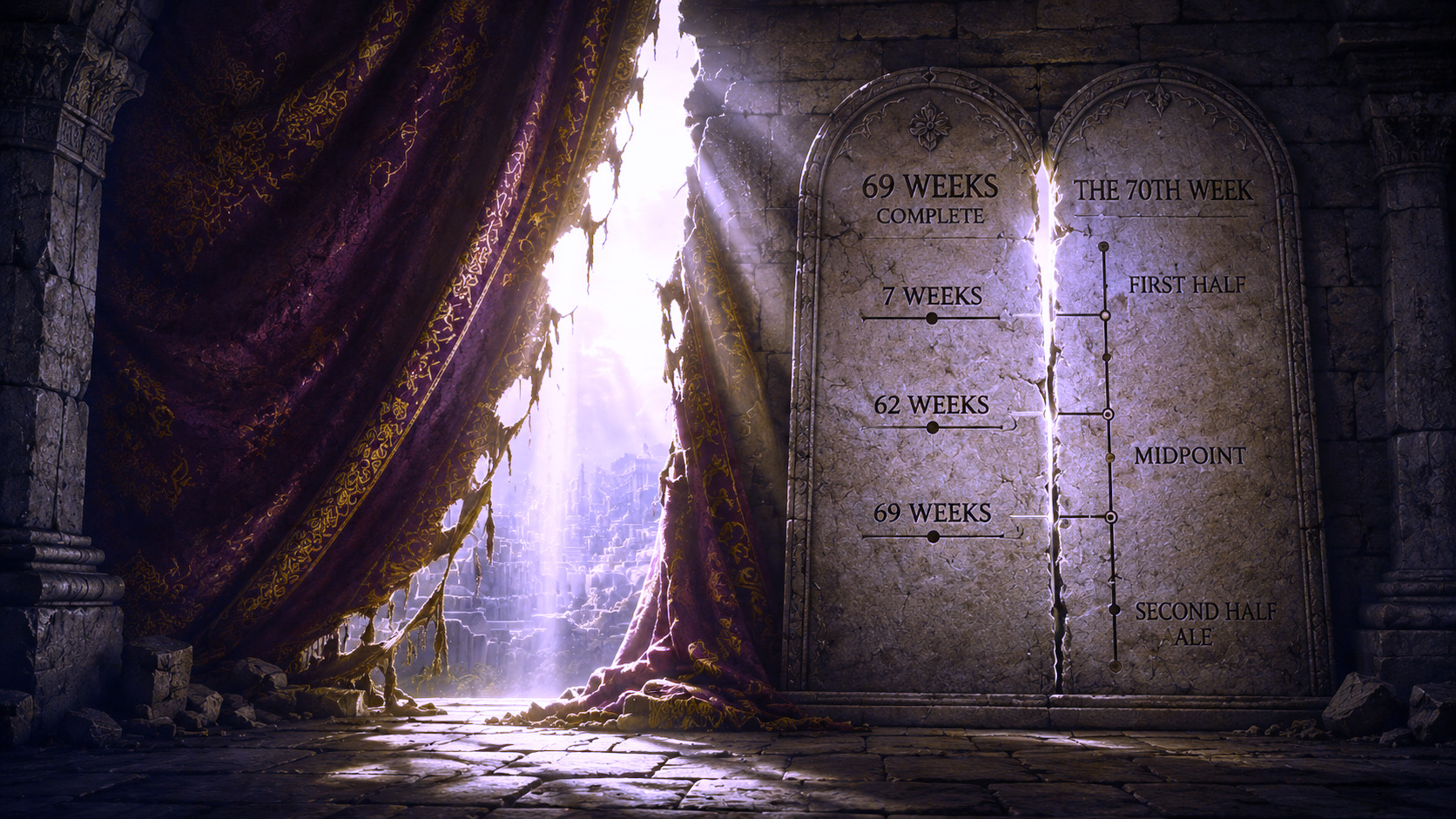
Today let's talk about the seventy weeks of Daniel, the last week, and the Prince.
Most of the churches I visit to worship God — the ones I go to with Jesus's guidance, listed on MightySons.org — teach the usual Nicene-council-derived seven-year tribulation that's all future tense. The common view is that Antichrist signs a peace treaty with Israel, breaks it in the middle, sets up an abomination in a rebuilt third temple, and the world burns for forty-two months. That's the script. That's what's preached from the pulpits.
Here's the problem. None of it survives the text.
Who Is "He"?
And he shall confirm the covenant with many for one week: and in the midst of the week he shall cause the sacrifice and the oblation to cease, and for the overspreading of abominations he shall make it desolate, even until the consummation, and that determined shall be poured upon the desolate. — Daniel 9:27 (KJV)
Who is "he"? The nearest antecedent is Messiah the Prince in verse 26. You cannot grammatically jump the pronoun over the Messiah and pin it on a future antichrist who has not been introduced anywhere in the passage. They do it anyway. They do it because Scofield said to.
The Honest Read
The honest read splits the seventieth week down the middle. The first three and a half years are Christ's ministry. He confirmed the covenant with many. In the midst of the week, at the cross, He caused the sacrifice and the oblation to cease. The veil ripped. Heaven stopped honoring the system.
The back half of the seventieth week is held in reserve. There IS a gap. The gap is the Ekklesia. The gap is the age of the Gentiles. And during this gap, WE are the third temple.
Know ye not that ye are the temple of God, and that the Spirit of God dwelleth in you? — 1 Corinthians 3:16
The temple did not disappear at the cross. It was rebuilt out of living stones.
The Unmeasured Stretch
How long does the gap last? Nobody knows. Not the angels. Not even the Son.
Of that day and that hour knoweth no man, no, not the angels which are in heaven, neither the Son, but the Father. — Mark 13:32
Gabriel measured everything else in this prophecy down to the day. The Ekklesia age is the one stretch he did not measure, because the Father reserved that timing to Himself. That is not a flaw in the prophecy. That is the design.
What we DO know is that He left, and He said He was coming back to gather His own. Call it the harvest. Call it the marriage supper of the Lamb. The crowd that mocks "the rapture" still has to answer for the gathering, because Christ Himself promised it. You can reject the dispensational packaging without rejecting the harvest itself.
Three Measurements, One Period
That is why every prophetic timestamp at the end of Revelation reads "time, times, and half a time" — one, plus two, plus a half, equaling three and a half — alongside 1260 days and forty-two months. Three measurements. One period. The unspent half-week.
When the Back Half Begins
When does that back half finally begin? When the marriage supper of the Lamb is set. When those who were washed and made white — Daniel's purified ones — are taken in. The moment the bride is seated, the dragon is cast down. Not primarily by Michael's sword. By the testimony of the saints.
And they overcame him by the blood of the Lamb, and by the word of their testimony. — Revelation 12:11
The Ekklesia is what casts him out of heaven. And then come the words that ought to give pause to the pulpits:
Woe to the inhabiters of the earth and of the sea! for the devil is come down unto you, having great wrath, because he knoweth that he hath but a short time. — Revelation 12:12
A short time. Forty-two months. The back half of the seventieth week, finally spent. And on the other side of the consummation, the Prince builds the temple Ezekiel saw — one mile square — and fills it Himself.

The Deeper Diagnosis: Lost at the Three
Now here is the deeper diagnosis. Why does the whole dispensational system get every one of these moves wrong? Because somewhere in the fourth century, the fallen church got lost at the three. They invented a triune God to manage a mystery they didn't have the patience to sit with, and once you train a church to look at ONE and find THREE, the habit metastasizes everywhere it goes.
One Christ across all of history? They split Him. The God of the Old Testament becomes "the Father," the Messiah becomes "the Son," the King who returns is the Son but somehow not the same Son who walked Galilee. You can't say "Jesus walked with Abraham, Jesus died on the cross, Jesus is coming back" as one continuous sentence without somebody calling you a heretic.
One Prince across the prophets? They split Him. Daniel's Prince, Ezekiel's Prince, Messiah the Prince — three figures where the text gives one.
One half-week measured three ways? They split it. Time-times-half-a-time, 1260 days, forty-two months become three separate tribulations when the math is identical.
They got lost at the three. They cannot see the One.
Receipt: The Fourth-Century Addition (Matthew 28:19)
In that same fourth century, when the Trinitarian apparatus was being built at Nicea and after, they reached into Matthew 28:19 and added a triadic baptismal formula that appears nowhere else in the New Testament. Every recorded baptism in the book of Acts is "in the name of Jesus." Acts 2:38. Acts 8:16. Acts 10:48. Acts 19:5. The apostles were standing right there when those Matthew 28 words were supposedly spoken, and not one of them ever obeyed the triadic formula in practice.
Eusebius, writing before Nicea, quoted Matthew 28:19 short — just "go and teach all nations in my name." After Nicea, the triadic phrasing suddenly begins appearing in his quotations. They added words.
Receipt: The Sixteenth-Century Addition (The Comma Johanneum)
About a thousand years later, around the sixteenth century, they did it a second time. The Comma Johanneum — the phrase in 1 John 5:7-8 about the Father, the Word, and the Holy Ghost being three that bear witness in heaven — was not in any Greek manuscript that Erasmus could find when he assembled his first two Greek editions. He left it out, was attacked for leaving it out, and demanded that anyone produce a single Greek manuscript containing the phrase and he would include it. One suspiciously convenient manuscript appeared, almost certainly produced for the occasion, and he added the phrase to his third edition under pressure. That is the verse that put the Trinity onto the page of the King James Bible.
And what was already there in the verse before they crowned it with their addition? The Spirit, the water, and the blood — three witnesses on earth pointing to ONE Son. They saw a "three" in the text and couldn't help themselves. They had to mirror it with a heavenly three to manufacture a proof.
Receipt: Isaiah 9:6 — Five Titles, One Son
Isaiah 9:6 calls the Son "Wonderful, Counsellor, the Mighty God, the everlasting Father, the Prince of Peace." Five titles. One Person. If Trinitarians ran their hermeneutic on Isaiah 9:6 the way they run it on Matthew 28:19, they would be obligated to invent a Pentinity. They don't, because they know — when it suits them — that titles are not Persons.
Let's go deeper, because this verse rewards a closer look.
The verse begins: "For unto us a child is born, unto us a son is given." One child. One son. Then the government — singular — rests on his shoulder. Then his name — singular — is called by five titles.
1. Wonderful — 𐤐𐤋𐤀 (Pele)
The Hebrew is Pele. That same root appears in Judges 13:18, where the Angel of the LORD appears to Manoah and his wife. Manoah asks the Angel's name and the Angel answers that his name is pil'i — from the same Pele root. KJV translates it "secret," other versions render it "wonderful." Either way, the Angel of JHVH already carried that exact divine identifier in the Old Testament. Isaiah is not coining a new title in chapter 9. He is identifying the Son with the same divine messenger who had been showing up throughout Israel's history.
2. Counsellor — 𐤉𐤅𐤏𐤑 (Yo'etz)
The wise planner, the one who advises. Paul calls Christ "the wisdom of God" in 1 Corinthians 1:24. The Son is the executive counsel through whom the Father's purposes are carried out.
3. Mighty God — 𐤀𐤋 𐤂𐤁𐤅𐤓 (El Gibbor)
This is where it becomes impossible to dodge. That exact phrase — El Gibbor — is used of JHVH Himself in Isaiah 10:21, just one chapter later: "the remnant shall return, even the remnant of Jacob, unto the mighty God." Same title. Same author. Same prophet. One chapter apart. The Son is called El Gibbor. The God of Israel is called El Gibbor. The titles overlap because the figure is the same figure.
4. Father of Eternity — 𐤀𐤁𐤉-𐤏𐤃 (Avi-ad)
The KJV renders this "the everlasting Father," but the Hebrew is Avi-ad — Father OF eternity, not "the everlasting Father" the way KJV makes it land. He's the forefather of the age. The originator of eternal life. The One from whom eternity comes forth. That is not Trinitarian Father-language at all. That is the Son as the source through whom the eternal age is brought forth. Trinitarians read the KJV phrasing and think the verse is handing them a paradox. The Hebrew is handing them a title.
5. Prince of Peace — 𐤔𐤓 𐤔𐤋𐤅𐤌 (Sar Shalom)
The Sar — the Prince, the ruler — who brings peace. The same Sar that walks Daniel's and Ezekiel's visions.
Read Around the Verse
Two verses before, Isaiah 9:1-2 says, "The people that walked in darkness have seen a great light: they that dwell in the land of the shadow of death, upon them hath the light shined." Matthew quotes that passage directly when Jesus moves His ministry to Capernaum and Galilee (Matthew 4:14-16). The prophecy of the light coming to Galilee and the prophecy of the child given with five titles are part of the same paragraph. Same Son. Same arrival.
One verse after, Isaiah 9:7 says, "Of the increase of his government and peace there shall be no end, upon the throne of David, and upon his kingdom, to order it and to establish it with judgment and with justice from henceforth even for ever. The LORD of hosts will perform this."
JHVH of armies executes the establishing of the Son's throne. And the Son is called El Gibbor — the same title given to JHVH in the next chapter — precisely because the Son carries the Father's name. He has no separate name of His own. He came in the Father's name, sent forth bearing the Father's titles.
I am come in my Father's name, and ye receive me not: if another shall come in his own name, him ye will receive. — John 5:43
Pele, El Gibbor, Avi-ad, Sar Shalom — Father-names worn by the Son who was sent in the Father's name. The Father remains invisible and unbegotten. The Son is the One sent forth, the One seen, the One reigning — always in the name of the One who sent Him.
And that is exactly what makes the Trinitarian fragmentation so dangerous. They have split a Son who never had an identity separate from the Father into a Person standing alongside Him with His own attributes. They have turned the messenger into a second God. And in doing so, they have set up the very condition the Son warned about in John 5:43 — they have prepared a population eager to receive someone who comes in his own name.
Micah 5:2 Stacks On Top
But thou, Bethlehem Ephratah, though thou be little among the thousands of Judah, yet out of thee shall he come forth unto me that is to be ruler in Israel; whose goings forth have been from of old, from everlasting. — Micah 5:2
Mimei olam. From the days of eternity. He doesn't begin in Bethlehem. He just arrives there in flesh.
Two prophets, one identity. The Son who has always been the active One — who walked Eden in the cool of the day, who wrestled Jacob, who led Israel out as the Angel of JHVH, who stood with the three in the furnace, who came in flesh at Bethlehem, and who is coming back as King. Same Person all the way through.
The Shema Was Always There
Meanwhile the Shema — the verse Jesus Himself called the greatest commandment — says "Hear, O Israel: the LORD our God is one LORD." Not three. One. The foundational confession of the people of God is a confession of unity, and they walked right past it on their way to a fourth century council.
They got lost at the three. They cannot see the One. And once that hermeneutic was locked in, they couldn't see the one Prince across the prophets, the one Christ across all of history, or the one half-week measured three ways. The eschatology breaks because the Christology broke first.
If your eschatology has to wedge the pause in BEFORE week seventy even starts, just to make room for a future antichrist inside it, your eschatology is wrong. The pause comes after the midpoint. The midpoint was the cross. The cross is what ended the sacrifice. And the bride is what ends the gap.
The Receipts — KJV
Daniel 9:25-27
"Know therefore and understand, that from the going forth of the commandment to restore and to build Jerusalem unto the Messiah the Prince shall be seven weeks, and threescore and two weeks... And after threescore and two weeks shall Messiah be cut off, but not for himself... And he shall confirm the covenant with many for one week: and in the midst of the week he shall cause the sacrifice and the oblation to cease..."
The only "he" in the passage is Messiah the Prince. The dispensational reading skips Him and pins the pronoun on an antichrist never introduced.
Matthew 27:50-51
"Jesus, when he had cried again with a loud voice, yielded up the ghost. And, behold, the veil of the temple was rent in twain from the top to the bottom..."
The real cessation of sacrifice. Heaven ripped its own veil at the cross. Their midpoint is a future treaty break — the actual midpoint already happened.
Revelation 11:1-2
"Rise, and measure the temple of God, and the altar, and them that worship therein. But the court which is without the temple leave out, and measure it not; for it is given unto the Gentiles: and the holy city shall they tread under foot forty and two months."
Read the KJV phrase the way it actually sounds — "the court which is without the temple." Without. Lacking. The court that has no temple. John measures the temple, the altar, and them that worship therein — the Ekklesia, the living-stones temple, the spiritual altar. What he is told to leave out is the court that has no temple in it: the world during the gap, trod down by the Gentiles for forty-two months. The dispensational system needs a third Herodian building standing at the midpoint just to produce an "outer court" worth excluding. The text gives them no building at all. No temple in the court. Only living stones, and a world without.
Revelation 11:3-12 — The Two Witnesses
"And I will give power unto my two witnesses, and they shall prophesy a thousand two hundred and threescore days, clothed in sackcloth. These are the two olive trees, and the two candlesticks standing before the God of the earth..."
"And when they shall have finished their testimony, the beast that ascendeth out of the bottomless pit shall make war against them, and shall overcome them, and kill them. And their dead bodies shall lie in the street of the great city... And they that dwell upon the earth shall rejoice over them, and make merry, and shall send gifts one to another; because these two prophets tormented them that dwelt on the earth."
And here — straight inside the same 1260-day window — the devil is arraigned before the world. The two witnesses stand in the court that has no temple, the public square of the great city, and prophesy the devil's case against him in plain hearing. He is tormented. He is exposed. He cannot answer their testimony, so he kills the messengers — and the world throws a holiday over their corpses, because the trial they brought against the devil is the trial the world has been refusing. Then God raises them up in the sight of their enemies and calls them home, and the dragon's hour is short (Rev 12:12). The testimony of the witnesses on earth and the casting down of the dragon from heaven are the same event seen from two sides.
Mark 13:32
"But of that day and that hour knoweth no man, no, not the angels which are in heaven, neither the Son, but the Father."
Gabriel measured every other stretch of Daniel's prophecy down to the day. The Ekklesia age is the one segment he did not measure, because the Father reserved that timing to Himself. That is not a missing piece. That is the piece.
Romans 11:25
"For I would not, brethren, that ye should be ignorant of this mystery, lest ye should be wise in your own conceits; that blindness in part is happened to Israel, until the fulness of the Gentiles be come in."
The gap has a name. It is the age of the Gentiles. It runs until the fulness comes in — and then the seventieth week resumes.
1 Corinthians 3:16
"Know ye not that ye are the temple of God, and that the Spirit of God dwelleth in you?"
The temple did not disappear at the cross. It was rebuilt out of living stones. During the gap, WE are the third temple. A rebuilt Herodian structure has no place in the sequence.
1 Thessalonians 4:16-17
"For the Lord himself shall descend from heaven with a shout, with the voice of the archangel, and with the trump of God: and the dead in Christ shall rise first: Then we which are alive and remain shall be caught up together with them in the clouds, to meet the Lord in the air..."
You can mock "the rapture" all you want. You still have to explain the gathering, because the Lord Himself promised it. Reject the dispensational packaging without rejecting the harvest itself.
Daniel 7:25 + Revelation 12:14 + Revelation 11:3 + Revelation 13:5
"...and they shall be given into his hand until a time and times and the dividing of time." (Daniel 7:25)
"...where she is nourished for a time, and times, and half a time, from the face of the serpent." (Revelation 12:14)
"And I will give power unto my two witnesses, and they shall prophesy a thousand two hundred and threescore days..." (Revelation 11:3)
"And there was given unto him a mouth speaking great things and blasphemies; and power was given unto him to continue forty and two months." (Revelation 13:5)
One plus two plus a half equals three and a half. 1260 days equals three and a half years. Forty-two months equals three and a half years. Three measurements. One period. The unspent half-week.
Revelation 12:11-12
"And they overcame him by the blood of the Lamb, and by the word of their testimony... Woe to the inhabiters of the earth and of the sea! for the devil is come down unto you, having great wrath, because he knoweth that he hath but a short time."
The dragon is cast down by the testimony of the saints, not by a peace treaty. He has a short time because the bride is already seated. The wrath of the world is the panic of a defeated enemy on a clock.
Acts 2:38 — vs. Matthew 28:19
"Then Peter said unto them, Repent, and be baptized every one of you in the name of Jesus Christ for the remission of sins, and ye shall receive the gift of the Holy Ghost." (Acts 2:38)
"...baptizing them in the name of the Father, and of the Son, and of the Holy Ghost..." (Matthew 28:19)
The apostles were standing there when Matthew 28 was supposedly spoken. Not one of them ever obeyed the triadic formula in practice. Every recorded baptism in Acts is "in the name of Jesus" — Acts 2:38, Acts 8:16, Acts 10:48, Acts 19:5. Eusebius quoted Matthew 28:19 short before Nicea and triadic after. They added words.
1 John 5:7-8 (The Comma Johanneum)
"For there are three that bear record in heaven, the Father, the Word, and the Holy Ghost: and these three are one. And there are three that bear witness in earth, the Spirit, and the water, and the blood: and these three agree in one."
The heavenly three was not in any Greek manuscript Erasmus could find when he assembled his first two Greek editions. He added it to his third edition under pressure after one suspect manuscript appeared on demand. The earthly three — Spirit, water, blood — pointing to ONE Son was already there. They saw a "three" in the text and couldn't help themselves. They had to mirror it.
Deuteronomy 6:4 — The Shema
"Hear, O Israel: The LORD our God is one LORD."
The verse Jesus Himself named the greatest commandment. The foundational confession of the people of God is a confession of unity. They walked past it on the way to a fourth century council.
Isaiah 9:6
"For unto us a child is born, unto us a son is given: and the government shall be upon his shoulder: and his name shall be called Wonderful, Counsellor, The mighty God, The everlasting Father, The Prince of Peace."
One child. One son. One government. One name — called by five titles. If Trinitarians ran their hermeneutic on Isaiah 9:6 the way they run it on Matthew 28:19, they would be obligated to invent a Pentinity.
John 5:43
"I am come in my Father's name, and ye receive me not: if another shall come in his own name, him ye will receive."
The Son carries the Father's name. He has no separate name of His own. Pele, El Gibbor, Avi-ad, Sar Shalom — Father-names worn by the Son sent in the Father's name. Trinitarian fragmentation turns the messenger into a second God, preparing a population eager to receive someone who comes in his own name.
The Son who was sent by the Father. The King who is coming. The Lord who reigns. Three titles. One JAHshuA.
In the 3rd month of Sivan on the 2nd day.
Derek Stirnemann, Ekklesia Way
(May 17th, 2026 Gregorian)